In Japan… Sam Jok Oh is also very visible in the Ancient and in the Present.
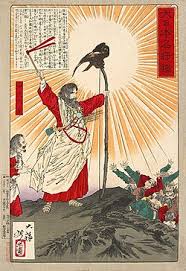
According to the record and passed down story or so called, myth, the very first Emperor of Japan, Jinmu Tennou, was helped by the Crow called Yatagarasu to reach Nara prefecture area today to open the Yayoi Period; this period is one of the most critical periods in Japanese history where Hunter / Gatherer style of the Jomon period transforms into a structured and productive rice farming economy. And, did you know that oldest artificial rice is from Korean peninsula 15,000 years ago? (Sorori) When you consider this fact with the the idea of Crow, and the location of Yayoi period, which was just above Kyushu where it is closer to Korean peninsula, it is no wonder that the earliest form of rice found in Japan begins in Kyushu region… and we see so many correlational evidences between Korea and Japan today because although many records may be gone and the history books may have been tweaked, what really actually happened can not lie, and what really actually happened was that many people from the Peninsula crossed to go to Japan, especially the forgotten 4th Kingdom, 가야 Gaya, and became integral and central part of the Japanese society, and during the Colonial time when USA took Philippines and Japan took Korea, Japan brought out a claim that because the Southern Region of Korean peninsula was once ruled by Japan, their taking over of Korea is just taking back old land (임나일본설), and interestingly, here is an explanation unheard before.
임나 is actually Japanese way of saying 가야, and there are many evidences of 가야 interaction with Japan especially with Steel trade – 가야 was excellent smelters like any other Horsemen culture and Japan couldn’t smelt metal, so they imported all steel from 가야. Because of this history, many of the Ruling Class of Japan were from 가야, and when 가야 fell, they fled to Japan, so it’s logical for their history book to tweak this fact and express it the way they want. And when you add the fact that the very first Japanese official history book was written by 태안만려 who is also from the Peninsula, it is not a surprise that he wrote this story of Japanese ruling of the South of the Peninsula where he is originally from.
In 1979, in a random Tea field, a Tomb was accidentally discovered that surprised the whole nation.
It was a Tomb of 태안만려 / 太安萬侶 / おおの の やすまろ who is known to have written the very first Official Japanese history book, and what was so surprising was that the the alignment and formation of the Tomb was completely that was Goguryo… Japanese scholars claimed that 태안만려 hired Goguryo people to make his Tomb, but he is strictly Japanese… but why would he have Goguryo artisans make his Tomb? Especially when he was such a huge important high ranking officer in Japan who wrote the Official history of Japan unless he had some sort of connection to Goguryo? According to the record, he is from 백제 Baek Jae – he fled the chaos of the kingdom falling and came to Japan as well as thousands of other Baek Jae people, and Baek Jae is Royally connected with Goguryo so there is a good hint as why he had his Tomb built the way it was. I think there certainly is something that needs to be analyzed and studied further because there is something going on here…
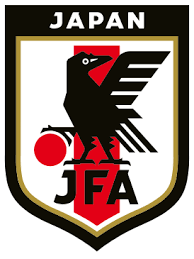
Today, JFA (Japanese Football Association) uses Sam Jok Oh as their logo. According to Google search, first reason is exactly because of the Jinmu Tennou story where the Crow, Yatagarasu, help guide Jinmu to safety. Second reason is because Japanese also see 3 Legged Crow as a sacred messenger of Amaterasu, a Supreme Sun God, so the 3 major ideas – Sun God, Crow and Three – all appear in this connection with Sam Jok Oh, and even linguistically, there are many connections.
Kudara Nai / 쿠다라 나이 / くだらない – The meaning of this phrase is useless, worthless, and etc… saying this to a person is an ultimate insult in Japanese culture.
This is combination of 2 words – Kudara and Nai.
Nai means doesn’t have, nonexistent, empty. Then what is Kudara?
Kudara is the calling of Ancient Korean Kingdom, 백제 (Baek Jae / 百濟) which I mentioned earlier, and Baek Jae started from Royal family of Goguryo, so both countries are related by Royal blood; hence, there is an undeniable relationship between Baek Jae and Goguryo so it can be said that there is a connection between Ancient Japan and Goguryo as well, which is why Three Legged Crow of Goguryo is found in Japan. And if I took this linguistic link to another level…
Today, Korean and Japanese are known to be part of Altai language family (although there is a debate that Korean is an isolated language, but I speak both languages fluently, so I know both are same), and there are too many similar words in both cultures. Below is in Hanzi >> Japanese + Japanese sound in Korean + English sound >> Korean + English sound >> English meaning
- 家族 >> かぞく카조쿠 kazoku >> 가족 gajok >> Family
- 約束 >> やくそく 야쿠소쿠 yakusoku >> 약속 yaksok >> Promise
- 無料 >> むりょう 무료 mooryo >> 무료 mooryo >> Free
- 準備 >> じゅんび 준비 joonbee >> 준비 joonbee >> Prepare
- 計算 >> けいさん 케이산 keisan >> 계산 gehsan >> Calculate
- 圖書館 >> としょかん 토쇼칸 toshokan >> 도서관 dosogwan >> Library
- 教科書 >> きょうかしょ 쿄우카쇼 kyowookasho>> 교과서 gyogwasuh >> School Books
If you compare the Japanese sound in Korean vs Korean and review, you can see that they are visually very similar, and it is because Korean is phonetic writing system where the words are exactly how the sounds are made in the body, so it is able to quantify sounds visually so once you understand the logic, it is quite very easy to learn. Here is my Youtube on this topic, and when you compare the quantified sounds of Japanese pronunciation and normal Korean pronunciation, it is clear that they are very close (for example, ㄱㅋ are both Wood sound, so you can see how ㅋ changes to ㄱ in Promise, but it is within the same element of Wood, and the shapes are cunningly same). And when you mix in the Mandarin…
- 家族 >> かぞく카조쿠 kazoku >> 가족 gajok >> 지아주 jiā zú >> Family
- 約束 >> やくそく 야쿠소쿠 yakusoku >> 약속 yaksok >> 유에슈 yuēshù >> Promise
- 無料 >> むりょう 무료 mooryo >> 무료 mooryo >> 우랴오 wú liào >> Free
- 準備 >> じゅんび 준비 joonbee >> 준비 joonbee >> 준베이 zhǔnbèi >> Prepare
- 計算 >> けいさん 케이산 keisan >> 계산 gehsan >> 지수안 Jìsuàn >> Calculate
- 圖書館 >> としょかん 토쇼칸 toshokan >> 도서관 dosogwan >> 투슈관 Túshū guǎn >> Library
- 教科書 >> きょうかしょ 쿄우카쇼 kyowookasho >> 교과서 gyogwasuh >> 지아오커슈 Jiàokēshū >> School Books
If you just compare the Korean sounds of the Chinese, and review vs the Japanese Korean and Korean, you can notice something…
- 家族 >> 카조쿠 >> 가족 >> 지아주 >> Family
- 約束 >> 야쿠소쿠 >> 약속 >> 유에슈 >> Promise
- 無料 >> 무료 >> 무료 >> 우랴오 >> Free
- 準備 >> 준비 >> 준비 >> 준베이 >> Prepare
- 計算 >> 케이산 >> 계산 >> 지수안 >> Calculate
- 圖書館 >> 토쇼칸 >> 도서관 >> 투슈관 >> Library
- 教科書 >> 쿄우카쇼 >> 교과서 >> 지아오커슈 >> School Books
There are sound change rules that show how exactly the sounds are changing. In Korean, we have words go underneath a word to make it 3D, and we call it 밭침 – we can call it the Root word for now in English, and Northern dialects can not pronounce these so they either elongate out or omit it, and both Japanese and Mandarin are Northern dialects that follow this sound change rule. In the given example, you can see this in the words Family and Promise. In Family, ㄱ in 족 is the Root word and in Japanese, this has been taken out and become a separate word 쿠 where ㄱ changed to ㅋ keeping the Elemental relationship. In Mandarin, ㄱ in 족 disappears while ㅗ flips to become ㅜ, so these two changes show how Root words can not be digested in Northern dialect so they were elongated in Japanese and omitted in Mandarin. If you take the next word, Promise, same can be found. Japanese elongated both ㄱ Root words, and in Mandarin, first ㄱ becomes one of the 4 Chinese intonations then disappears and the second ㄱ just disappears. Additionally, ㅑ in Korean becomes ㅠ in Mandarin, keeping the duo line concept and ㅗ flips again and becomes ㅠ so line count increased while the visually reciprocal relationship remains.
What about the ㄴ Root word for Prepare or Library? I said Northern Dialect can’t pronounce the Root word… This is explained in 훈민정음 해례본. In Far East Asia theory of Ying and Yang, it says Fire and Water are the most basic necessities in Life, and Fire sounds are ㄴ N / ㄷ D / ㅌ T / ㄹ L while water sounds are ㅇNg / ㅎ H, so this explains why in Mandarin, there are only 2 Root words which are Fire N and Water Ng – N with nin 您 and Ng with ning 寧, so N being present as Root word in Chinese for Prepare and Library is ok, keeping it within the Ying Yang theory.
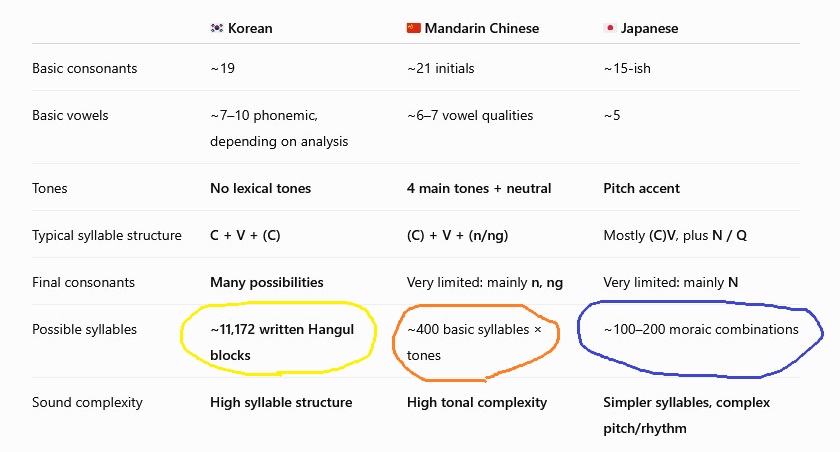
And ㄱㅋㄲ (Tree sounds) in Korean changes to ㅅㅈㅊ (Metal Sounds) in Chinese, so last name 김 Kim is pronounced 진 Jin in Mandarin, and the best word in English to show this is the word G. This word has 2 pronunciations – G as in Girl, and this G is like Gh and is ㄱ in Korean while there is G as in Geometry, and this G is more like J sound which is ㅈ in Korean, so G word alone shows above mentioned Elemental change between Tree and Metal sound, and that’s why Ghengis Khan is pronounced 칭키스칸 Chingkiskhan / 징기스칸 Jingghiskhan and 겐기스칸 Ghengis Khan – it is Ch ㅊ Metal to J ㅈ Metal or Ch ㅊ Metal to Gh ㄱ Tree. And 길림 吉林 Gil Lim in Korean is 지린 Ji Lin in Mandarin, and 계림 鷄林 Geh Lim in Korean is also 지린 Ji Lin in Mandarin, so Chinese sounds are actually pretty simple and limited compared to the diversity in Korean. After all, Korean uses 24 characters out of 28 total to make 11,100 sound combinations which is the most in the world, while Chinese makes about 1600 and Japanese only makes 110…
- Firstly, the Northern dialects can’t pronounce the Root word that it gets elongated or omitted as can be seen in the word Promise, and Japanese and Mandarin both are Northern dialects. Please note I don’t say Chinese – instead, I use Mandarin to indicate Northern region while Canton 켄톤 is same as Guangdong 광동 in Mandarin sound and is Southern Dialect.
- Another interesting one is McDonald. Japanese is 마쿠도나루도 (Makudonarudo), Korean is 맥도날드 (Mehk Do Nahl Dew), and Chinese is 마이당라오 (Mài dāng láo) – if you just take these pronunciations and ask a regular American Joe to guess, he would never guess it’s McDonald in Japanese and Chinese because they are WAY off… For Japanese, too many words end on Vowels that limits their sound combinations, leading to a disaster of Makudonarudo and for Chinese, they just use the closest sounding character, so there are many weird word combinations of characters in Chinese for foreign words like McDonald or city names (for example – Los Angeles is Luòshānjī 洛杉磯, KFC is Kěndéjī 肯德基, and New York is Niǔyuē 纽约 >> meaning based writing is being used to represent sound, so of course there will be huge disharmony in conversion as shown). Korean is a syllable language so every stress in a word is same while the English stresses only one vowel in a word, and based on which vowel is emphasized, the pronunciation complete changes, and Chinese shares this same characteristic by having 4 up and downs. The name Blake (pronounced B sound + Lake) as we know can be pronounced as B * LAH * Kee if vowel A was stressed which completely changes the pronunciation, so it’s confusing! Here is Key and Peele Skit that handles this topic very directly (Key & Peele – Substitute Teacher)
- Secondly, there is ㄱ >> ㅈ changes from Tree to Metal like the word G (Girl and Geometry). In the word Family, Calculate, and School Books, repeating pattern of ㄱ becoming ㅈ can be found just like the way Korean last name Kim 킴 is Gim 김 in Korean and Jin 진 in Mandarin. There are a few other sound rules that exist such as ㅅ S changing to ㄷ D (황제 Hwang Jeh in Korean is 황띠 Huang Di in Mandarin), and ㅇOh changing to ㅅS (여자 Yeo Jah in Korean in 죠세이 Jo sei in Japanese which is like how Jose / Juan are written with ㅈ J but pronounced as ㅎ H)
- Thirdly, Hanzi pronunciation of the word in three different languages are very similar because all three countries are related somehow with Horsemen culture, and Korea is regionally in the middle of both and serves as a bridge between the left and the right in many ways including the language.
- the word speed in Chinese / Korean / Japanese is 슈두 速度 Sùdù / 속도 Sok do / 소쿠도 そくど Sokudo. In Japanese, ㄱ in 속 is elongated out to 쿠 and in Mandarin, ㄱ in 속 is omitted and ㅗ flips to become ㅠ or ㅜ, and if you compare Japanese and Chinese directly without Korean, it lacks the explanation on the 쿠 sound in Japanese. However, if you put Korean in the middle, you can see that it can go right side Japanese to explain the 쿠 and it can go left side China to explain the ㄱ drop.
- Here is Youtube video (all in Korean, but AI can help translate) that explains the Sound change between Korean and Mandarin which relates to Japanese as Northern speech.
- Korean has tendency to shorten and abbreviate sound – Love 爱 in Chinese and Japanese is 아이 Ai and Korean is 애 Eh. 애 is ㅏ Ah and ㅣ Ee combined, so Korean 애 Eh for Love is truncated version of Ai. Another modern word is 먹방 Mukbang – this is short for 먹는 방송 (Eating Show) and became 먹방. And conversely, Chinese and Japanese have tendency to widen and make bigger, so that’s why they separateㅏ Ah and ㅣ Ee and pronounce as Ai
- Korean has tendency to pronounce crisp and clear – Sky 天 in Chinese is tiān 티엔, and Korean is 천 Chun, and Japanese is 텐 Ten. With Korean pronunciation in the middle, this is Metal Sound ㅊ changing to Fire Sound ㅌ, and ㅊ ch becoming ㅌ t is making the sound more obtuse and cloudy – feeling of thicker. And this is why Qingdao is pronounced as Queendao 퀸다오 among White people versus Chingdao 칭다오 in Mandarin versus Tsingdao ㅌ싱다오, and T ㅌ + S ㅅ ultimately makes ㅊ Ch sound for Cheengdao pronunciation.
Another interesting proof of Japanese root with the Northern Horsemen is the story of the Nine-Tail Fox, the main theme of world famous Anime, Naruto.
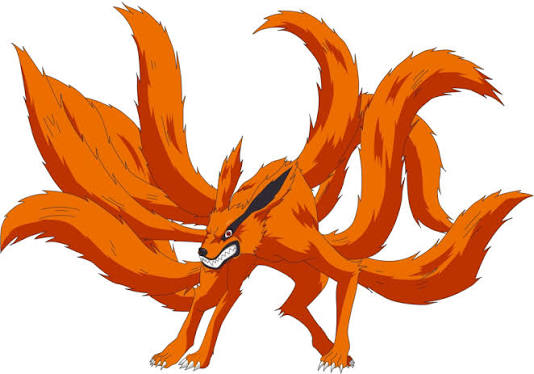
- This is a well-known story in China, Korea and Japan. The story from Korea is that Nine-Tail Fox is an evil women who lived for 1000 years, and she needs the blood of young men in order to continue living young and beautiful. She is generally used in lot of scary folklore stories, and her vampiric actions align with Dracula story in the West because Romanians / Bulgarians (Bulgaria from my finding is same as 가야 or its other name, 불가야 Bulgaya) are originally Horsemen people from the Asian side just like the Huns, so this story of eternal life by eating live human intestines in Asia has been replaced with symbolism of sucking blood instead, but the idea of taking in blood to live forever is same for both Nine-Tail Fox and Vampires like East and the West.
- 9 is 3 repeated 3 times, which is why the Temple of Heaven in Beijing China built by Jurchen of Manchuria is all in multiple of three, and Kabbalah of Judaism is also same except it represents 10, the Heaven while in Asia, we say after 9, it goes to 0 and repeats the cycle. Korean ancient teaching of 천부경 Chun Boo Gyoung also talks about this in 81 characters (again, multiple of 3) that from 0, comes 1 and cycles thru to 9 and back to 0 to restart again just like the way Sun rises and falls everyday.
- Naruto is a famous Japanese Anime where the main character has Nine-Tail Fox in the stomach, and as the story progresses, the anime introduces other special people who had Tailed monsters that are inside them as well, starting from One-Tail, Two-Tail all the way to Eight, and when One thru Nine combine, it becomes Ten Tail Beast to fight the ultimate boss. So the fact that the story revolves around the Nine-Tail is staying true to the Asian notion of 천부경 where it goes 0 thru 9 and resets to 0, and the combinations of all the Tails to become Ten-Tail is same as Kabbalah where 10, the Heaven, is represented.
- Based on these information and facts, how far is Naruto from Sam Jok Oh and the Horsemen culture especially the North of the peninsula where Great Goguryo was? Not that far… Considering how Horsemen swept the World history like Mongols, Turks, Huns, Khitan, Magyar, Jurchens and etc… it is no wonder that such Horsemen characteristics are showing in Japan in the past and now.
From the very first founder of Japan Jinmu Tennou and Yayoi Period until Modern Japan today with JFA Logo as well as the language, there are heavy connections to Sam Jok Oh and the Northern Horsemen culture at the foundational base of Japanese society, which is why there are cultural references to the Three Legged Crow and which is why the language is showing same sound change rule, but these sound change rules are not bound to Asian languages. I just mentioned about Latin on the second point with Jose and Juan, and in grand scheme of things, it’s not about the language and the sound change, but it’s just purely about sound change alone which is bound by the rules of this Universe we are living in – Sun and the Moon with 5 Elements for the 7 days in a week, and the Trinity (Father, Mother, and Son), so that’s why these sound change patterns keep showing up in other languages, not just Far East Asian languages simply because we are living in a world which was built by God with rules that we can follow.
P.S.
With this realization, Japan needs to apologize for the recent crimes to humanity that they caused especially during the Colonial time and during the 1592 Invasion of Korea for 7 years. I will dare say that it’s like – you raised a dog, and the dog later bit you… Too much of the culture and the people originally came from the Peninsula from 가야 steel trade history and 백제 migration after the fall as well as 고구려 painters and artists to 신라 화랑 which became the base for Samurai culture. That’s why the DNA testing proved that modern Japanese DNA is more than 80% match to Korean DNA as well as the Manchurian DNA… But Japan is a vertical society just like China whereas Korea is horizontal. Vertical means that the order comes from Top to Bottom whereas Horizontal means that things are more equally spread out, so that’s why Koreans get real jealous when others do better because of this Horizontal equality notion whereas in Japan and China, they follow orders from stronger entity, so if you see Japan, they have been the puppet for USA ever since 1945. Before that, Japan has always looked at China and applied this verticality by revering China and copying everything such as Solar / Lunar Eclipse records that didn’t happen in Japan, so unless you are stronger, Japan will never bow down, and until recently, Korea has been viewed by Japan as under them, but now, things are changing…
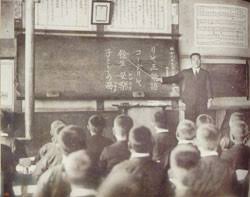
During Japanese Colonial occupation from 1909 to 1945, they tried to erase Korean culture by destroying the language – they prohibited usage of Korean, forced everyone to get a Japanese name, and demanded everyone to learn Japanese history and to use Japanese. Right now that I am writing this is 2026, so it’s about 100 years ago… Today, the young Japanese generations like 10s 20s and 30s are busy watching K-drama, listening to K-pop and learning Korean language, and this is causing a family feud in Japan because many families still live with 3 generations under the same roof (grand parents, parents and kids), and these grand parents are still stuck in the old thinking where they look down on Korea, but their grand children come home from school talking mainly about Korean culture – like BTS / Black Pink, K-Drama, K-Beauty, K-Food… so the grand parents and grand children fight – grand parents will be like – why are you watching Korean stuff? They are just dogs that we used to rule before… grand children will be like – I LOVE JUNG KOOK! I LOVE JENNY! STOP TELLING ME TO STOP LISTENING TO SONGS I LOVE! What a hypocritical twist of events… The ones who tried to wipe out our culture and Korean language are now crazed about learning our culture and our language…
And this is why Japan needs to repent because Karma is coming according to many future readers and scholars – Japan is sinking and will be under the Ocean. Ruth Montgomery said it, Edgar Cayce said it, and Korean monk 탄허 said it along with many others. Japan may be our blood-related family, but they have been away too long living in an island with their own ways while importing advanced knowledge, culture and technology from us in the peninsula. And yet, they pointed their bloody swords back at their older brother and older sister who gave them everything they needed to survive and grow… how can the system of Universe NOT punish these ingrates? The Universe only knows to balance, and Japan has so much imbalance with all the negative energies they created… Look at the Nuclear waste water dumping of 2023 from 2011 Tsunami that led to the Plant meltdown in East Japan. The whole world said don’t dump it into the Ocean, and in the end, they still did… and will be for the next 30 years! The media stopped covering it, but that doesn’t mean they are not dumping any more… All these inconsiderate actions will come back to them in the process of the Universe balancing itself, and that’s why Japan will be under the ocean in the imminent future – 인과응보 / 因果應報 / Karma will be real and exponentially multiplicative of the crimes committed. In Korean, we say – you harvest what you have sown. If you planted Beans, Beans will grow and if you planted Red beans, Red beans will grow. It sounds pretty stupidly basic and obvious, so if you planted hatred, arrogance, selfishness, distrust, scheme, plot, lies… what you will harvest are these negative energies, and that is exactly the situation of Japan in 2026 today with their Yen plummeting and with their country being downgraded to Third world country from Advanced country, and countless social issues that are being reported in Japan today.
According to 탄허 monk of Korea, 70% of Japan will be under water and will volunteer to be a colony of Korea, so there is still saving grace for some Japanese whether they deserve it or not… with the sinking, Japan will have paid the price of their sin and will prosper under the 홍익인간 notion of Korean ideology to help people and the world as we Koreans have been in the past 30 years such as helping rice farming in Senegal, Africa or helping a minority group in Indonesia keep their language by sharing Korean writings or selling 2 re-fitted Naval ships to Philippines for a dollar each to fight against Chinese navy to repay the debt of being the first SE Asia country to come to aid Korea during the Korean War and etc… the Time is near and Sky Land opening will commence once all the ice has melted in the both poles, and Mother Earth will go ahead and shake herself to re-align the tilt on Earth from 23.5 degrees to 0 degrees, and when it does, Heavenly cleansing will happen where millions will die physically due to the axis movement and where millions will die due to spiritual inadequacy that will dry up their souls, and the new world, will be led by the Chosen people.